
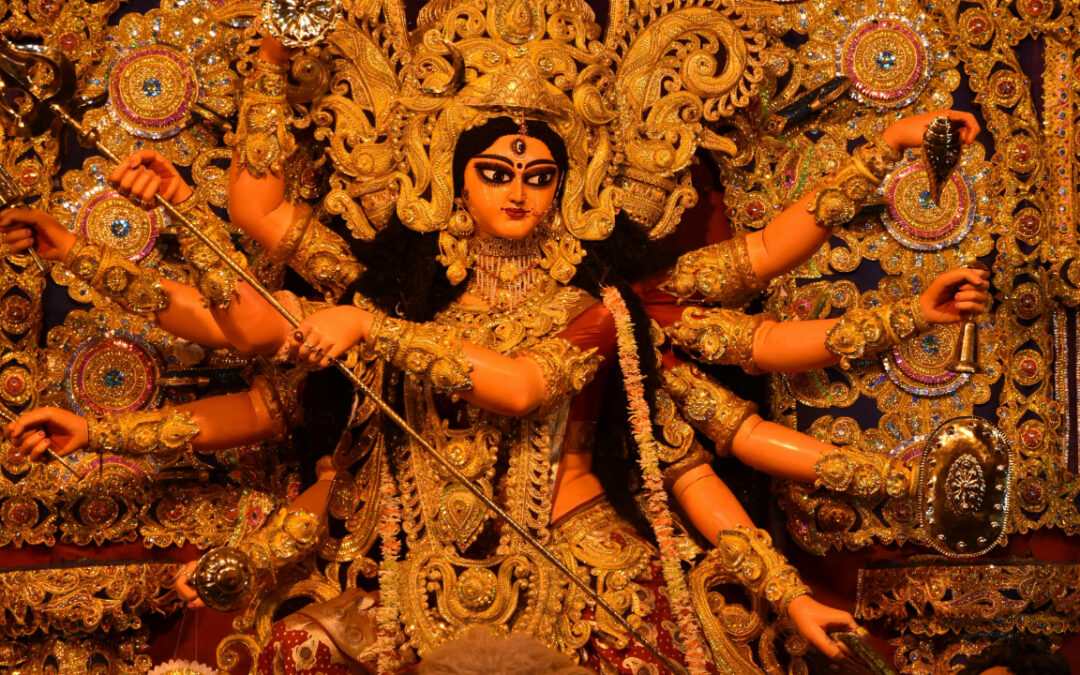
Durgā
The One who bestows the three
holding them tenderly
in Her never-ending smile.
Your three fingers
granting us all wisdom
gestures to the Sky.
Your soaring home towering
beyond suffering
where we aspire to roam freely.
You conquered our fears with Your might.
You vanquished the demons
troubling even the Gods.
Roaring on Your lion throne.
You are the invincible Heart of Totality
Yet bending low to comfort us gently.
~ Mā Umā-Pārvatī
The myriad sādhanas of Śrī Vidyā display the many forms of the Divine Mother with the intricacy and beauty of a kaleidoscopic mosaic. Dimensional and alluring, each aspect shape shifts with time, place, and circumstance, revealing timely wisdom and timeless subtlety to each practitioner. Every deep plunge in the cycle of sādhana hints at even greater mysteries to taste in the endless Oneness.
Navarātrī allows for a deep plunge into sādhana, which is the time many practitioners look forward to most.
Through direct experience, we know our devotion, ardor, and discipline will encounter an encompassing and palpable collective atmosphere.
The astronomical alignment that signals Navarātrī amplifies the dimensions and depth of sādhana, opening a doorway to more bliss from the dazzling depths of this mosaic mystery. Each Navarātrī is calibrated to different aspects of the Divine Mother, which is further attuned to the season’s particular rasa (flavor, mood) that adorns Her. This display of an ever-changing mosaic paradoxically discloses Her unchanging Oneness through Her constantly changing forms.
When viewed from the outside, these celebrations are often seen as agricultural festivals or social gatherings for rural populations. On one level, this is true and meaningful for many. Yet, there is another unique alignment that these nine nights open for practitioners, giving them an opportunity for deeper and intensified sādhana. Traditionally, there was a Navarātrī for each of the six seasons that the Indian calendar notes. However, most lineages acknowledge four Navarātrī to accompany the four main seasons of the modern calendar.
Of the four main Navarātrī, the Spring and Autumn ones are the most popular and celebrated in India and the two main ones for honoring Durgā Mā.[1] Durgā is the beloved mother and protectress throughout the Indian subcontinent and to many sādhikās worldwide.
While there is no shortage of affairs that people desire protection from, we sādhikās seek protection essentially from our own ignorance and deluded perceptions.
We also aim to uncover and nurture our strength to meet challenges and difficulties from everyday life and the deeper entanglements from patterns of defending a nonexistent Self. An inner resilience rebounds from Her imagery and mantra, recovered from where this busy world’s endless activities and sensory influx often bury it.
We become further inspired by listening to the tales of Her exploits in the Devī Māhātmyam, which is a guide to our inner process. Devī Māhātmyam is an epic tale of the Divine Mother’s manifestation and battles that gain us protection and liberation from our entanglements and suffering. It translates to the Glory of Devi. It’s a wondrous, sonorous, time-bending tale written in a secret code that reads as a narrative on one level, is a sonic prescription of mantras on another level, and is a poem of metrical beauty and accuracy telling the story of our beloved Divine Mother.
To me it’s a marvel that we get to hear about Her life and how She restored power and harmony to even the gods, which is to say, how we recapitulate our powers from a fearful and miserly existence.
The time-bending aspect is evident as the first sentence frames the story in the past while discussing events that will occur in the future. Encoded in the sentence, in this curious time-lapse phrase, is the Tantric Praṇavabīja sound Hrīṁ [2]. And likely many have decoded as I have the heart bija mantra of Tripurasundarī in this exact phrase. It’s a fascinating convention to frame a story in this curious time sequence, at the start perhaps pointing to the temporality of Consciousness and the power of the Mother to grace us in the temporal and nontemporal. She is beyond limits. It might also point to the simultaneity and dimensionality of Oneness.
In Tantra, there is an understanding that everything is contained within everything. This means an infinite, unending entanglement of all things. Nothing is static. It’s alive, ever oscillating, and ever renewing itself. This dynamism is a quality of Her power. As Durgā, She wields this power effortlessly and masterfully, usually without breaking Her smiling countenance.
The syllable Dur refers to words that mean fortress—secure or inaccessible places.
Durgā is the One who is inaccessible in Her secured position and, from there, creates a fortress for us to take refuge in Her strength.
This refuge allows us to understand our minds and see through the imposed veils of distorted perception from an overactive and discursive mind. She also gives us the courage to meet our root existential fears. Portrayed as a warrior, Durgā conveys the strength and fortitude in Her energy matrix with the power required to combat our internal weaknesses and delusions. Durgā is an expression of Śakti- the primordial force of Consciousness and its reflective light of totality. While there are endless manifestations of this Oneness not only mathematically but creatively, as this is Her sport, there is an underlying warrior quality to all forms of Śakti.
Śakti impels Herself with strength and vigor, and Her movements have an innate purpose- to express is to create anew.
Creativity and manifestation are Her delights and chosen sport, just as we may enjoy hiking or playing tennis. The best example of this expression is children. Everything from them is inherently creative. Consciousness expands with directed strength and creativity in the mode of development and growth. Creativity’s essence is fearlessness, as are children at play. Imaginative, expansive, and unburdened by efficiency and demands of productivity, they fearlessly create worlds from which they integrate and make sense of this world. While Durgā embodies and emphasizes this fearlessness and strength, it underlies the movement of Śakti herself.
Often, we question the meaning of life. And the question that has puzzled many of us since we were young is, “Why is there something rather than nothing?” Indeed, I will not answer these intriguing and important questions with my understanding as the point is in individual recognition and resolution. As we each reconcile this in proper embodied knowledge, (not just mentally, which rarely satisfies or only until the subsequent undoing leaves us in doubt and dissatisfaction,) something is fulfilled.
Our felt and known understanding reconciles and allows Her general vector and thrust of expansion and movement to continue creatively, thus propelling our lives with value. The question churns up an impetus to know and to dismantle what we think we know. To approach this question is to act with direction and strength.
Śakti is the fortitude to inquire about what we think we know, and Durgā is the strength and organized intelligence to dismantle and reconstruct meaningfully.
She is seen as a mother, embodying the maternal principle of responding to us. She is legendary for reacting quickly, as any mother would to her child in crisis or difficulty. She brings in Her response- Consciousness’s limitless and unbounded possibilities beyond the realm of the human maternal instinct. One of Her most accessible and well-known manifestations is in groups of nine called Navadurgā. There are likely many sequences of nine, and I have heard whisperings about nine streams of nine, but I am only directly familiar with three main transmission streams. Of these three, one is most commonly known. In this stream, the nine Durgā are: Śailaputrī, Brahmacāriṇī, Candraghaṇṭā, Kūṣmāṇḍā, Skandamātā, Kātyāyanī, Kālarātrī, Mahāgaurī, Siddhidātrī. Though this sādhana stream includes Kālarātrī, who reveals Herself in a terrific form, it is still considered a benign sequence. Benign because of how She dismantles our fears and ignorance and the ease and accessibility of Her power and presence. The other two sequences of the three Navadurgā schemas increase in wrathfulness and intensity of sādhana.
Numbers are not random or only symbolic in this philosophical system. They are calculations of precise qualities and equations that reveal how the dynamic operates successively, revealing different dynamics or qualities as the equation changes. Three is the essential number, as creation and our human existence happen in triads.
The undifferentiated unifying state of Consciousness unfolds within itself to create the many from the One. The Absolute moves from one to three and continues in a triune descent in materialization.
The primary triad of knower, knowing, and the known is experienced in the three states all humans (and, according to the Tantras, all incarnated beings) experience: waking, dreaming, and deep sleep. The first triad of the knower, etc, experiencing the above three states of Consciousness, gives us nine permutations of interaction and thus the equation of number nine attributed to the Divine Mother.
The nine forms of Durgā Mā, most widely known as Navadurgā, mentioned above represent a different equation of nine. They display the underlying triune attribute of Absolute Consciousness as sat-cit-ānanda interacting with the tri-gunas. They give us the previously mentioned stream of nine, primarily Durgā’s gentle emanations. Sat-cit-ānanda (saccidānanda) is the triadic description or pointer to Absolute Consciousness. The Absolute expresses itself in three attributes or expressions- Sat chid, and ānanda. Sat – wholeness and chid – beingness merge and unfold together as ānanda. Usually understood as bliss, this makes sense if we don’t confuse bliss with fleeting everyday happiness. Bliss isn’t more of a permanent happiness but the unending experience of the highest state of unity. Permanent isn’t possible in a matrix of impermanence, where we dwell in the relative world.
Bliss gives freedom, fullness, and mastery, as represented in the multifarious forms of Śakti. She is the unity, freedom, and fullness masterfully sporting in and with the world.
Another system sees Navadurgā as conquering the existential fears in the mind that are veiling our inner light. These fears prohibit our crossing into unifying void states. Left unmet and undissolved, they fragment in the layers of our body and mind.
We must overcome these deep-seated fears that can be confronted sequentially and precisely in the nine nights of Navarātrī, plunging us deeper into previously unknown and often feared realms of the psyche.
This excavating of existential fears results in a fiercer display of Durgā, culminating in the very wrathful and uncompromising manifestation of Chandi. The transmission lineages of this Navadurgā expression delve precisely into the state of waking, dreaming, and sleeping, as well as the forms of Durgā that can remove illusions and delusion from the subconscious and unconscious. These nine forms are beyond fierce manifestations! This extraordinary wrath is necessary to dismantle the profoundly inaccessible layers of our being. Therefore, I only hint and do not name the sequence here.
Another calculation involving nine is in the nine seed syllables of the Divine Mother’s root mantra, the Navarna (nine colors/qualities) mantra. Each bija is a force of the Divine Mother’s unsurpassable power and dismantles our delusional perceptions, revealing the underlying Oneness. Through the Navarna mantra, She contains the summit of Her triadic power displayed in the power of Mahālakṣmī, Mahākālī, and Mahāsarasvatī. Again, we experience them as modes of power and expression in the waking, dreaming, and deep sleep states, giving us 3×3= 9. We see that the number nine is inextricable from Her sādhana methodology. Nine is the basic structure of reciting the Chandi path, the colloquial and affectionate name of the Devī Māhātmyam, which is Her foremost sādhana.
When I was young, I was fascinated that yogis of different traditions outside and sometimes even antagonistic to the Shakta point of view would recite Devī Māhātmyam at Navarātrī. It seems, to all She is the Mother. On Her Navarātrī, in a descriptive legend, we hear that Durgā will leave Her heavenly Himalayan abode (meaning at the summit and out of material reach) and descend into our lives.
With Durgā comes strength, intelligence like a strategic war commander, and its accompanying perseverance. Yet, She responds to us out of Her motherly compassion.
The Oneness is seeking us also.
And though life sometimes or often feels like a battlefield, it is not barren of Mother’s benevolence, Her tender gaze, and Her ever-present hand ready to uplift us. And like human mothers, She runs to us because we are Her children.
There is no more excellent qualification than our existence.
[1] In Śrī Vidyā, the spring Navarātrī is dedicated to Tripurasundarī. However more common is to Durgā
[2] Famously decoded by the great Śrī Vidyā polymath Sri Bhāskarāya.
Photograph by Photo by Tanuj Adhikary on Unsplash
Durgā
Aquella que otorga los tres
sosteniéndolos tiernamente
en Su sonrisa sin fin.
Tus tres dedos
concediéndonos toda la sabiduría
gestos hacia el Cielo.
Tu altísimo hogar se eleva
más allá del sufrimiento
donde aspiramos recorrer libremente.
Conquistaste nuestros miedos con Tu poder.
Has vencido a los demonios
perturbando incluso a los dioses.
Rugiendo en Tu trono de león.
Eres el invencible Corazón de la Totalidad
Y aun te inclinas para consolarnos suavemente.
~ Mā Umā-Pārvatī
Los innumerables sādhanas de Śrī Vidyā muestran las múltiples formas de la Madre Divina con la complejidad y la belleza de un mosaico caleidoscópico. Dimensional y atrayente, la forma de cada aspecto cambia con el tiempo, el lugar y las circunstancias, revelando sabiduría oportuna y sutileza atemporal a cada practicante. Cada inmersión profunda en el ciclo de sādhana insinúa misterios aún mayores que saborear en la infinita Unidad.
Navarātrī permite una inmersión profunda en sādhana, que es el momento más esperado por muchos practicantes.
Por experiencia directa, sabemos que nuestra devoción, ardor y disciplina encontrarán una atmósfera colectiva envolvente y palpable.
La alineación astronómica que señala Navarātrī amplifica las dimensiones y la profundidad del sādhana, abriendo una puerta a más dicha desde las deslumbrantes profundidades de este misterio mosaico. Cada Navarātrī está calibrado para diferentes aspectos de la Madre Divina, que se sintoniza además con la rasa (sabor, estado de ánimo) particular de la estación que La adorna. Esta exhibición de un mosaico siempre cambiante revela paradójicamente Su Unidad inmutable a través de Sus formas constantemente cambiantes.
Desde fuera, estas celebraciones suelen verse como fiestas agrícolas o reuniones sociales de la población rural. Por un lado, esto es cierto y significativo para muchos. Sin embargo, hay otra alineación única que estas nueve noches abren para los practicantes, dándoles una oportunidad para sādhana más profunda e intensificada. Tradicionalmente, había un Navarātrī para cada una de las seis estaciones que señala el calendario indio. Sin embargo, la mayoría de los linajes reconocen cuatro Navarātrī para acompañar a las cuatro estaciones principales del calendario moderno.
De los cuatro Navarātrī principales, los de primavera y otoño son los más populares y celebrados en la India y los dos principales para honrar a Durgā Mā.[1] Durgā es la amada madre y protectora en todo el subcontinente indio y para muchos sādhikās de todo el mundo.
Aunque no faltan asuntos de los que la gente desea protegerse, los sādhikās buscamos protección esencialmente de nuestra propia ignorancia y percepciones engañadas.
También buscamos descubrir y nutrir nuestra fuerza para afrontar los retos y dificultades de la vida cotidiana y los enredos más profundos de los patrones de defensa de un Yo inexistente. Una resiliencia interior rebota de Su imagen y mantra, recuperado de donde las interminables actividades y la afluencia sensorial de este ajetreado mundo a menudo lo entierran.
Nos inspiramos aún más escuchando los relatos de Sus hazañas en el Devī Māhātmyam, que es una guía para nuestro proceso interior. El Devī Māhātmyam es un relato épico de la manifestación y las batallas de la Madre Divina que nos proporcionan protección y liberación de nuestros enredos y sufrimientos. Se traduce como la Gloria de Devi. Es un cuento maravilloso, sonoro, que dobla el tiempo, escrito en un código secreto que se lee como una narración en un nivel, es una prescripción sonora de mantras en otro nivel, y es un poema de belleza métrica y precisión que cuenta la historia de nuestra amada Madre Divina.
Para mí es una maravilla que nos cuente Su vida y cómo Ella restableció el poder y la armonía incluso a los dioses, es decir, cómo recapitulamos nuestros poderes de una existencia temerosa y mísera.
El aspecto de doblar el tiempo se hace evidente en la primera frase, que sitúa la historia en el pasado mientras se habla de acontecimientos que ocurrirán en el futuro. Codificado en la frase, en esta curiosa frase de desfase temporal, está el sonido Praṇavabīja tántrico Hrīṁ[2]. Y probablemente muchos han decodificado como yo el mantra bija del corazón de Tripurasundarī en esta frase exacta. Es una convención fascinante enmarcar una historia en esta curiosa secuencia temporal, al principio quizá apuntando a la temporalidad de Conciencia y poder de la Madre para agraciarnos en lo temporal y lo no temporal. Ella está más allá de los límites. También podría apuntar a la simultaneidad y dimensionalidad de la Unidad.
En el Tantra se entiende que todo está contenido dentro de todo. Esto significa un entrelazamiento infinito e interminable de todas las cosas. Nada es estático. Está vivo, siempre oscilando y siempre renovándose. Este dinamismo es una cualidad de Su poder. Como Durgā, Ella ejerce este poder sin esfuerzo y con maestría, normalmente sin romper Su semblante sonriente.
La sílaba Dur se refiere a palabras que significan fortaleza -lugares seguros o inaccesibles.
Durgā es Aquella que es inaccesible en Su posición segura y, desde allí, crea una fortaleza para que nos refugiemos en Su fuerza.
Este refugio nos permite comprender nuestras mentes y ver a través de los velos impuestos de la percepción distorsionada de una mente hiperactiva y discursiva. También nos da el valor para enfrentarnos a nuestros miedos existenciales fundamentales. Retratada como una guerrera, Durgā transmite la fuerza y la fortaleza de Su matriz energética con el poder necesario para combatir nuestras debilidades y engaños internos. Durgā es una expresión de Śakti – la fuerza primordial de la Conciencia y su luz reflexiva de totalidad. Si bien hay un sinfín de manifestaciones de esta Unidad no sólo matemáticamente sino también creativamente, ya que este es Su deporte, hay una cualidad guerrera subyacente a todas las formas de Śakti.
Śakti se impulsa con fuerza y vigor, y Sus movimientos tienen un propósito innato- expresar es crear de nuevo.
La creatividad y la manifestación son Sus deleites y Su deporte elegido, al igual que podemos disfrutar de senderismo o jugar al tenis. El mejor ejemplo de esta expresión son los niños. Todo de ellos es inherentemente creativo. La conciencia se expande con fuerza dirigida y creatividad en el modo de desarrollo y crecimiento. La esencia de la creatividad es sin miedo, como son los niños jugando. Imaginativos, expansivos y sin la carga de la eficiencia y las exigencias de la productividad, sin miedo crean mundos desde los que integran y dan sentido a este mundo. Mientras que Durgā encarna y enfatiza esta ausencia del miedo y fuerza, subyace el movimiento de la propia Śakti.
A menudo nos cuestionamos el sentido de la vida. Y la pregunta que nos desconcierta a muchos desde que somos jóvenes es: “¿Por qué hay algo en lugar de nada?”. De hecho, no voy a responder a estas intrigantes e importantes preguntas con mi entendimiento, ya que el punto está en el reconocimiento y la resolución individuales. A medida que cada uno de nosotros reconcilia esto en el conocimiento encarnado adecuado, (no sólo mentalmente, que rara vez satisface o sólo hasta que el deshacer posterior nos deja en la duda y la insatisfacción,) algo se cumple.
Nuestra comprensión sentida y conocida reconcilia y permite que Su vector general y empuje de expansión y movimiento continúen creativamente, impulsando así nuestras vidas con valor. La pregunta agita un ímpetu por conocer y desmantelar lo que creemos saber. Abordar esta pregunta es actuar con dirección y fuerza.
Śakti es la fortaleza para indagar sobre lo que creemos saber, y Durgā es la fuerza y la inteligencia organizada para desmantelar y reconstruir con sentido.
Se la considera una madre, que encarna el principio maternal de responder ante nosotros. Es legendaria por reaccionar con rapidez, como lo haría cualquier madre ante un hijo en crisis o con dificultades. Ella trae Su respuesta – las posibilidades ilimitadas e inabarcables de la Conciencia, más allá del ámbito del instinto maternal humano. Una de Sus manifestaciones más accesibles y conocidas es en grupos de nueve llamados Navadurgā. Probablemente hay muchas secuencias de nueve, y he escuchado susurros acerca de nueve corrientes de nueve, pero sólo estoy directamente familiarizada con tres corrientes principales de transmisión. De estas tres, una es la más comúnmente conocida. En esta corriente, las nueve Durgā son: Śailaputrī, Brahmacāriṇī, Candraghaṇṭā, Kūṣmāṇḍā, Skandamātā, Kātyāyanī, Kālarātrī, Mahāgaurī, Siddhidātrī. Aunque esta corriente de sādhana incluye a Kālarātrī, que se revela en una forma terrorífica, se le sigue considerando una secuencia benévola. Benévola por cómo Ella desmantela nuestros miedos e ignorancia y por la facilidad y accesibilidad de Su poder y presencia. Las otras dos secuencias de los tres esquemas de Navadurgā aumentan en ira e intensidad de la sādhana.
Los números no son aleatorios o sólo simbólicos en este sistema filosófico. Son cálculos de cualidades precisas y ecuaciones que revelan cómo opera la dinámica sucesivamente, revelando diferentes dinámicas o cualidades a medida que cambia la ecuación. El tres es el númeroesencial, ya que la creación y nuestra existencia humana suceden en tríadas.
El estado unificador indiferenciado de la Conciencia se despliega en sí mismo para crear los muchos a partir de la Unidad. El Absoluto pasa del uno al tres y continúa en un descenso trino en la materialización.
La tríada primaria de: conocedor, conocimiento y lo conocido, se experimenta en los tres estados que todos los humanos (y, según los Tantras, todos los seres encarnados) experimentan: vigilia, sueño y sueño profundo. La primera tríada del conocedor, etc, experimentando los tres estados de Conciencia anteriores, nos da nueve permutaciones de interacción y por lo tanto la ecuación del número nueve atribuido a la Madre Divina.
Las nueve formas de Durgā Mā, más ampliamente conocidas como Navadurgā, mencionadas anteriormente representan una ecuación diferente de nueve. Muestran el atributo trino subyacente de la Conciencia Absoluta como sat-cit-ānanda interactuando con las tri-gunas. Nos dan la corriente de las nueve anteriormente mencionadas, principalmente las emanaciones suaves de Durgā. Sat-cit-ānanda (saccidānanda) es la descripción triádica o indicador de la Conciencia Absoluta. El Absoluto se expresa en tres atributos o expresiones- Sat chid, y ānanda. Sat – totalidad y chid – ser se funden y despliegan juntos como ānanda. Normalmente entendido como dicha, esto tiene sentido si no confundimos la dicha con la felicidad cotidiana fugaz. La dicha no es una felicidad permanente, sino la experiencia interminable del estado más elevado de unidad. Lo permanente no es posible en una matriz de impermanencia, donde moramos en el mundo relativo.
La dicha da libertad, plenitud y maestría, como se representa en las múltiples formas de Śakti. Ella es la unidad, la libertad y la plenitud que se desenvuelven con maestría en y con el mundo.
Otro sistema ve Navadurgā como la conquista de los miedos existenciales en la mente que están velando nuestra luz interior. Estos miedos nos impiden entrar en estados de vacío unificador. Si no se resuelven, se fragmentan en las capas de nuestro cuerpo y nuestra mente.
Debemos superar estos miedos profundamente arraigados que pueden afrontarse de forma secuencial y precisa en las nueve noches de Navarātrī, sumergiéndonos más profundamente en reinos de la psique previamente desconocidos y a menudo temidos.
Esta excavación de los miedos existenciales da como resultado un despliegue más feroz de Durgā, que culmina en la manifestación muy iracunda e intransigente de Chandi. Los linajes de transmisión de esta expresión Navadurgā profundizan precisamente en el estado de vigilia, sueño y sueño profundo, así como en las formas de Durgā que pueden eliminar las ilusiones y el engaño del subconsciente y el inconsciente. ¡Estas nueve formas están más allá de las manifestaciones feroces! Esta iracundia extraordinaria es necesaria para desmantelar las capas profundamente inaccesibles de nuestro ser. Por lo tanto, sólo insinúo y no nombro la secuencia aquí.
Otro cálculo que involucra el nueve está en las nueve sílabas semilla del mantra raíz de la Madre Divina, el mantra Navarna (nueve colores/cualidades). Cada bija es una fuerza del poder insuperable de la Madre Divina y desmantela nuestras percepciones ilusorias, revelando la Unidad subyacente. A través del mantra Navarna, Ella contiene la cumbre de Su poder triádico mostrado en el poder de Mahālakṣmī, Mahākālī, y Mahāsarasvatī. De nuevo, los experimentamos como modos de poder y expresión en los estados de vigilia, sueño y sueño profundo, lo que nos da 3×3= 9. Vemos que el número nueve es inextricable de Su metodología sādhana. Nueve es la estructura básica de la recitación del Chandi Path, el nombre coloquial y cariñoso del Devī Māhātmyam, que es Su principal sādhana.
Cuando era joven, me fascinaba que yoguis de diferentes tradiciones ajenas y a veces incluso antagónicas al punto de vista Shakta recitaran el Devī Māhātmyam en Navarātrī. Al parecer, para todos Ella es la Madre. En Su Navarātrī, en una leyenda descriptiva, oímos que Durgā dejará Su morada celestial del Himalaya (lo que significa en la cumbre y fuera del alcance material) y descenderá a nuestras vidas.
Con Durgā viene la fuerza, la inteligencia como un comandante estratégico de guerra, y la perseverancia que la acompaña. Sin embargo, Ella nos responde desde Su compasión maternal. La Unidad también nos está buscando.
Y aunque a veces o a menudo la vida parezca un campo de batalla, no está exenta de la benevolencia de la Madre, de Su tierna mirada y de Su mano siempre presente y dispuesta a levantarnos. Y como las madres humanas, Ella corre hacia nosotros porque somos Sus hijos.
No hay calificación más excelente que nuestra existencia.
[1] En Śrī Vidyā, Navarātrī de primavera está dedicado a Tripurasundarī. Sin embargo más común es a Durgā
[2] Famosamente descifrado por el gran polímata de Śrī Vidyā Sri Bhāskarāya.
Fotografía de Photo by Tanuj Adhikary on Unsplash