
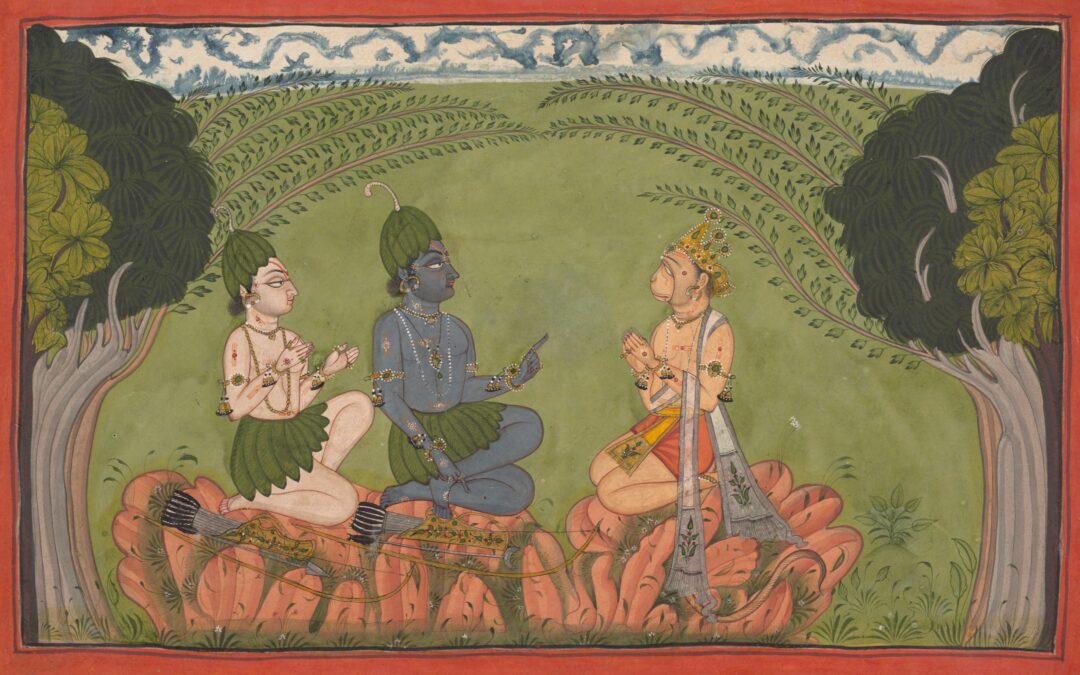
(Hanuman before Rama and Lakshmana: Folio from the dispersed “Mankot” Ramayana series. ca. 1710–25. https://www.metmuseum.org/art/collection/search/37986)
Myths, often dismissed as mere tales from the past or entertaining distractions, reveal profound wisdom when seen through the interior gaze of Vedic philosophy. This ancient Indian philosophical system provides a unique perspective, a distinct portal to plumb the outer realm of facts and delve into their inner realm of meaning. In this light, myths emerge as profound maps, each carrying a transformative potential that can stabilize our embodiment of our personal place in the world and the ultimate value of this life.
Therefore, proper understanding and education in mythology lies in understanding the deeper meanings of myths rather than solely focusing on their surface-level entertainment value. Education in this context is not reading commentaries and analysis of myths. They have their place to guide us when we are new, a starting point for our own embodiment. Education comes from the Latin to find our place in the universe. To approach myths as education is to find the stories within us to inform our personal unfolding journey, a map to the inner unexplored terrain.
Ultimately, we need to decode the story within ourselves to understand our place in the world of infinite forms as we appear and disappear in our inherent spectrum from formless and empty to form and fullness.
This process of decoding is a process of embodying and is crucial in understanding the transformative potential of myths and their relevance in our lives.
Myths are not just stories; they are personal and collective atlases in a narrative form that transcends time. Traditionally, they were spoken words that invited participation through the circle of listeners and the curvature of the repeating themes. By integrating the past, present, and future into a single, continuous narrative, myths connect us to a larger, timeless story that we can participate in anew.
Approaching myths from a purely psychological standpoint risks stripping them of their mysterious essence. We inadvertently rob them of their power to enchant and captivate our imagination by reducing them to mere symbols or archetypes. Recognizing the transformative potential of myths underscores their relevance and importance, compelling us to consider their impact on personal and societal growth.
Myths point us beyond our known confines and concepts.
Mythical expressions are akin to dream symbols. Just as dreams have a depth and richness that transcends the literal language of our waking lives, myths, too, possess an inherent bottomlessness and unlimited potential for interpretation. Relegated by conventional boundaries, language fails to capture the nuanced layers of meaning myths encapsulate. Mythic and dream language allows us to understand the pristine Consciousness from which all language and thoughts arise. Instead of limiting these languages to conform to the confines of the waking state language, we can learn their language and translate, thereby expanding the waking state language rather than associate within the known thought loops.
Myths, dreams, and poetry are cognate languages of unfettered Consciousness. Because we often dismiss these languages, we are disconnected from the source of understanding ourselves and the inherent harmony that we have of belonging. We seek outer power to control what we feel disconnected from, which is part of this personal self. As life loses inner significance and becomes even more transactional and essence is lost in mechanical timesheets and productivity outputs, we seek outer power and control where we have no outer recognition of our inner value.
While chances are high that anyone reading these musings understands and mourns this loss of significance and value, it may still be a significant and strange leap to seeing the value and role of myths. While many enjoy a good story, some only enjoy it if it wields power and gives something practical. How can fanciful tales of flying monkeys and constant battles restore meaning and place? Wouldn’t it involve decoding symbols, and who has time for that?
Yet, there is a place where we accept symbolic language and never dismiss it as unreal or a waste of time. It permeates every part of our life and, on deeper dimensions, our Consciousness. Math. It usually appeals to our sense of certainty through its unquestionable logical conclusions and appeals to our inner resonance for symmetry and order. Solving a confounding and complex problem around numbers and symbols is enormously satisfying. There’s a quiet elegance to its certainty. We approach the infinite and nonlinear through the symbols and language of linearity.
I propose that myths are challenging, confronting, and ultimately ‘solving’ similar problems of Consciousness through another symbolic language.
For instance, just as math uses symbols to represent complex equations and solve problems, myths use symbols to represent abstract concepts and guide us in understanding the world and ourselves.
Scientists can speak of gravity, and the Rishis spoke of Ganesha; one can speak of black matter or Pratyangira. Or, what about the finite sequence of infinity? I suggest we invoke that as Mahālakṣmī or Laḷitā. I don’t want to reduce these Īṣṭadevatā Consciousness fields to singular concepts that our linear and singular dimensional minds can grasp only in static ways. Īṣṭadevatās are multi-dimensional, linear and nonlinear, sequential and simultaneous, and also not that. We usually think in a dualistic paradigm, either this way or that way. But as Nāgārjuna pointed out in his famous catuṣkoṭi
- It is,
- It isn’t
- It is, and it isn’t
- Not it is, and not it isn’t[1]
Īṣṭadevatās are not static concepts but include concepts within their matrix. The point remains valid that we use symbols in our language to understand the ineffable. Yet, math securely falls into the category of hard facts and logic. Except for the forbidden dividing by zero.
On an outer level, numbers are universal symbols of the quantity of things. Delve into algebra and geometry, and we have symbols of symbols, and then we have the most revealing and confounding language of symbols in calculus. To me, calculus investigates and reveals Consciousness through symbols of reality, from emptiness to form, which I see in the symbols of zero to infinity.
Galileo Galilei said, “Mathematics is the language with which God has written the universe.”
Zero revolutionized our fundamental understanding of…well, everything. Add it to one side of the equation with a humble decimal point, and you reduce; add it to the other side and increase. It is a magical symbol with infinite powers. And infinity lures and taunts the scientists and the mystics. It taunts through its emptiness (or its symbol in math, zero).
Empty of Self, another dimension dawns. How do we empty of self, fulfill our worldly activities, and come to integral nothingness?
Some practitioners have very often heard me say that as science has its mathematical equations, Consciousness has mythological correlations. This brings to mind the astounding Śrīnivāsa Rāmānujan, who had unprecedented math genius and was primarily self-educated. He said he received insights from his Īṣṭadevatā Nāmagiri (a form of Mahālakṣmī) in the dream state.
Śrīnivāsa Rāmānujan said, “An equation has no meaning for me unless it expresses a thought of God.”[2]
Dreams are as real (or as unreal) as the waking state. We would benefit significantly from inquiring why we consider the waking state real or more accurate than the dreaming state. In Śrī Vidyā, we see that both arise from the underlying turīya state. So why does one arise as “real” and one as unreal”? The bias arises from our understanding of what is real. We collectively take what is stable and can be confirmed by the senses to be real and other things to be unreal or at least suspect. The dreaming state reveals an inner geography of personal history, philosophy, and psychology, while the waking state shows the collective experiences of the above. They exist interdependently, not separately. Outside of the confines of waking state temporality, the dream state is often expressed in intuitive flashes and circular sensual impressions.
In our times, myths are dismissed as falsehoods and nonsense and often criticized because of the different interpretations and levels on which somebody can read them. And how frequently they change! For some reason, critics want them to be the same static version in each telling. Yet the audience changes, the times change, and the storyteller changes. We grow and transform, and so do myths. This varying quality is essential. There are many ways to understand, and we can imagine multiple options in each situation.
If the story always ends the same, then we limit our freedom and creativity to meet things as new and different.
A static formulaic response propagates a mental monoculture. Each experience carries within it the possibility of being wholly unique and fresh, even with the same people and circumstances. Oral stories change as the storyteller changes.
When the story belongs to you, you have the power and the capacity to alter it. When the story is your body, it is yours to change, grow, and transform.
Ascertaining cosmic value and inherent meaning in a consumeristic and transactional society is challenging. Our everyday dualistic and linear language cannot convey this depth. This is likely why all who fall in love, at some point, start to feel poetic, seeking a more evocative voice for their experience.
We need a more encompassing way to point to something whose significance is greater than us. Myths guide us to understand our place in the world and our relationship with the Divine through language and unconfined meaning. Myths invite us to participate newly, breaking the linearity of conventional time. They integrate the past, present, and future into a single, continuous narrative. Indian myths do not begin with “once upon a time”; as they do not start in time, but rather in a curvature of space encompassing all time, including this moment where we participate anew.
Transcending the limits of time and its consequentially limited expressions, through the shape of mythology, we find a circle that allows changeability while always keeping us equidistant from the center (the power of its geometry) where the unchanging reposes.
Linear time is irreversible, at least at the speed of light. This mortality is its precious gift, and its shadow is its unidirectional vector. In contrast, circular time (Nityā Devyāḥ, for example) offers new opportunities for the same situations to arise again yet differently and freshly in this new context for each of us in this very moment and circumstance of our curve of time.
We have another new chance to float with the changing and choose different potentialities on the wave of the unchanging.
Participatory circular language allows us to experience, for instance, what Hanumān in the Rāmāyaṇa experienced, but in a fresh, new way within our limited temporal reality. In this manner, mythologies remain alive when they are embodied. We are not merely recapitulating or reenacting myths; we are delving into infinity and eternity, newly expressing timeless stories like the Rāmāyaṇa or the tale of the Maiden with No Hands, a heartbreaking and empowering story of trauma and its liberation. By living these narratives anew, we transform the dynamics of what can happen, a legacy we owe to future generations. Otherwise, they inherit a museum relic that is dry and dusty, devoid of the arch of infinity.
The circularity of time enables us to experience transcendence and immanence simultaneously. It allows us to stand on what never changes and flow with the part that changes. There is no definitive end in this changing continuum—something remains, continuously expressed in different forms. Thus, the circularity of time gives voice and body to the unchanging. When linearity and circularity are combined, they form a spiral, representing dynamic and harmonious communication and entanglement. This spiral of symbols and reality illustrates that we stagnate if we do not change and are locked in repetition (saṃsāra).
Infinity persists until time ends; eternity exists beyond time.
Here lies the spiral dance of emptiness and form, from zero to infinity, embodying the illogic of dividing by zero.
[1] Here, I see correspondences to the four avasthā. What would be the fifth if Nāgārjuna used the pentadic system of Śrī Vidyā going from the fourth avasthā turīya to turīyātīta?
[2] This quote is often cited in various sources, including the book “Ramanujan: The Man and the Mathematician” by S. R. Ranganathan (1967), and it is frequently mentioned in discussions about his life and work, illustrating how his intuition and religious beliefs played a crucial role in his mathematical journey.
(Hanuman ante Rama y Lakshmana: Folio de la serie dispersa “Mankot” Ramayana. ca. 1710-25. https://www.metmuseum.org/art/collection/search/37986)
Los mitos, a menudo descartados como meros cuentos del pasado o distracciones entretenidas, revelan una profunda sabiduría cuando se ven a través de la mirada interior de la filosofía védica. Este antiguo sistema filosófico de la India proporciona una perspectiva única, un portal distinto para sondear el reino exterior de los hechos y profundizar en su reino interior de significado. A la luz de esto, los mitos emergen como mapas profundos, cada uno de los cuales tiene un potencial transformador que puede estabilizar nuestra encarnación de nuestro lugar personal en el mundo y el valor último de esta vida.
Por lo tanto, la comprensión y la educación adecuadas en mitología radican en la comprensión de los significados más profundos de los mitos en lugar de centrarse únicamente en su valor de entretenimiento a nivel superficial. La educación en este contexto no es leer comentarios y análisis de mitos. Tienen su lugar para guiarnos cuando somos nuevos, un punto de partida para nuestra propia encarnación. La educación viene del latín para encontrar nuestro lugar en el universo. Acercarse a los mitos como educación es encontrar las historias dentro de nosotros para informar nuestro viaje personal, un mapa del terreno interior inexplorado.
En última instancia, necesitamos decodificar la historia dentro de nosotros mismos para comprender nuestro lugar en el mundo de las formas infinitas a medida que aparecemos y desaparecemos en nuestro espectro inherente de sin forma y vacío a la forma y la plenitud.
Este proceso de decodificación es un proceso de encarnación y es crucial para comprender el potencial transformador de los mitos y su relevancia en nuestras vidas.
Los mitos no son solo cuentos; son atlas personales y colectivos en una forma narrativa que trasciende el tiempo. Tradicionalmente, eran palabras habladas que invitaban a la participación a través del círculo de oyentes y la curvatura de los temas que se repetían. Al integrar el pasado, el presente y el futuro en una narrativa única y continua, los mitos nos conectan con una historia más grande y atemporal en la que podemos participar de nuevo.
Acercarse a los mitos desde un punto de vista puramente psicológico corre el riesgo de despojarlos de su esencia misteriosa. Sin darnos cuenta, les robamos su poder de encantar y cautivar nuestra imaginación al reducirlos a meros símbolos o arquetipos. Reconocer el potencial transformador de los mitos subraya su relevancia e importancia, obligándonos a considerar su impacto en el crecimiento personal y social.
Los mitos nos señalan más allá de nuestros confines y conceptos conocidos.
Las expresiones míticas son similares a los símbolos oníricos. Así como los sueños tienen una profundidad y riqueza que trasciende el lenguaje literal de nuestras vidas de vigilia, los mitos también poseen una insondabilidad inherente y un potencial ilimitado para la interpretación. Relegado por los límites convencionales, el lenguaje no logra capturar las capas matizadas de significado que encapsulan los mitos. El lenguaje mítico y onírico nos permite comprender la Conciencia prístina de la que surgen todos los lenguajes y pensamientos. En lugar de limitar estos lenguajes para que se ajusten a los confines del lenguaje del estado de vigilia, podemos aprender su lenguaje y traducirlo, expandiendo así el lenguaje del estado de vigilia en lugar de asociarnos dentro de los bucles de pensamiento conocidos.
Los mitos, los sueños y la poesía son lenguajes afines de la Conciencia sin restricciones. Debido a que a menudo descartamos estos lenguajes, estamos desconectados de la fuente de comprensión de nosotros mismos y de la armonía inherente que tenemos de pertenencia. Buscamos el poder externo para controlar aquello de lo que nos sentimos desconectados, que es parte de este yo personal. A medida que la vida pierde significado interno y se vuelve aún más transaccional y la esencia se pierde en las hojas de tiempo mecánicas y los resultados de productividad, buscamos el poder y el control externos donde no tenemos un reconocimiento externo de nuestro valor interno.
Si bien hay muchas posibilidades de que cualquiera que lea estas reflexiones comprenda y lamente esta pérdida de importancia y valor, aún puede ser un salto significativo y extraño para ver el valor y el papel de los mitos. Si bien muchos disfrutan de una buena historia, algunos solo la disfrutan si ejerce poder y brinda algo práctico. ¿Cómo pueden los cuentos fantásticos de monos voladores y batallas constantes restaurar el significado y el lugar? ¿No implicaría decodificar símbolos, y quién tiene tiempo para eso?
Sin embargo, hay un lugar en el que aceptamos el lenguaje simbólico y nunca lo descartamos como irreal o una pérdida de tiempo. Impregna cada parte de nuestra vida y, en dimensiones más profundas, nuestra Conciencia. La matemática. Por lo general, apela a nuestro sentido de certeza a través de sus incuestionables conclusiones lógicas y apela a nuestra resonancia interna para la simetría y el orden. Resolver un problema confuso y complejo en torno a números y símbolos es enormemente satisfactorio. Hay una elegancia tranquila en su certeza. Nos acercamos a lo infinito y no lineal a través de los símbolos y el lenguaje de la linealidad.
Propongo que los mitos desafían, confrontan y, en última instancia, “resuelven” problemas similares de la Conciencia a través de otro lenguaje simbólico.
Por ejemplo, al igual que las matemáticas utilizan símbolos para representar ecuaciones complejas y resolver problemas, los mitos utilizan símbolos para representar conceptos abstractos y guiarnos en la comprensión del mundo y de nosotros mismos.
Los científicos pueden hablar de gravedad, y los Rishis hablaron de Ganesha; se puede hablar de materia negra o Pratyangira. O, ¿qué pasa con la sucesión finita del infinito? Sugiero que lo invoquemos como Mahālakṣmī o Laḷitā. No quiero reducir estos campos de Conciencia Īṣṭadevatā a conceptos singulares que nuestras mentes lineales y dimensionales singulares puedan captar solo de manera estática. Los Īṣṭadevatās son multidimensionales, lineales y no lineales, secuenciales y simultáneos, y tampoco eso. Solemos pensar en un paradigma dualista, ya sea de una manera o de otra. Pero como señaló Nāgārjuna en su famoso catuṣkoṭi
- Es,
- No es
- Es y no es
- Ni es, ni no es[1]
Los Īṣṭadevatās no son conceptos estáticos, sino que incluyen conceptos dentro de su matriz. Sigue siendo válido el punto de que usamos símbolos en nuestro lenguaje para entender lo inefable. Sin embargo, las matemáticas entran en la categoría de hechos concretos y lógica. Excepto por la división prohibida por cero.
En un nivel externo, los números son símbolos universales de la cantidad de cosas. Si profundizamos en el álgebra y la geometría, tenemos símbolos de símbolos, y luego tenemos el lenguaje más revelador y confuso de los símbolos en el cálculo. Para mí, el cálculo investiga y revela la Conciencia a través de los símbolos de la realidad, desde el vacío hasta la forma, que veo en los símbolos del cero al infinito.
Galileo Galilei dijo: “Las matemáticas son el lenguaje con el que Dios ha escrito el universo”.
Cero revolucionó nuestra comprensión fundamental de… bueno, todo. Si lo añades a un lado de la ecuación con un humilde punto decimal, reduces; agréguelo al otro lado y aumente. Es un símbolo mágico con infinitos poderes. Y el infinito atrae y se burla de los científicos y los místicos. Se burla a través de su vacío (o su símbolo en matemáticas, cero).
Vacío de Ser, amanece otra dimensión. ¿Cómo nos vaciamos de nosotros mismos, cumplimos con nuestras actividades mundanas y llegamos a la nada integral?
Algunos practicantes me han oído decir muy a menudo que así como la ciencia tiene sus ecuaciones matemáticas, la Conciencia tiene correlaciones mitológicas. Esto trae a la mente al asombroso Śrīnivāsa Rāmānujan, quien tenía un genio matemático sin precedentes y fue principalmente autodidacta. Dijo que recibió percepciones de su Īṣṭadevatā Nāmagiri (una forma de Mahālakṣmī) en el estado de sueño.
Śrīnivāsa Rāmānujan dijo: “Una ecuación no tiene significado para mí a menos que exprese un pensamiento de Dios”.[2]
Los sueños son tan reales (o tan irreales) como el estado de vigilia. Nos beneficiaríamos significativamente si nos preguntáramos por qué consideramos que el estado de vigilia es real o más preciso que el estado de sueño. En Śrī Vidyā, vemos que ambos surgen del estado turīya subyacente. Entonces, ¿por qué uno surge como “real” y el otro como “irreal”? El sesgo surge de nuestra comprensión de lo que es real. Colectivamente tomamos lo que es estable y puede ser confirmado por los sentidos como real y otras cosas como irreales o al menos sospechosas. El estado de sueño revela una geografía interna de la historia personal, la filosofía y la psicología, mientras que el estado de vigilia muestra las experiencias colectivas de los anteriores. Existen de manera interdependiente, no separada. Fuera de los confines de la temporalidad del estado de vigilia, el estado de sueño se expresa a menudo en destellos intuitivos e impresiones sensuales circulares.
En nuestros tiempos, los mitos son descartados como falsedades y tonterías y a menudo criticados debido a las diferentes interpretaciones y niveles en los que alguien puede leerlos. ¡Y con qué frecuencia cambian! Por alguna razón, los críticos quieren que sean la misma versión estática en cada relato. Sin embargo, el público cambia, los tiempos cambian y el narrador cambia. Crecemos y nos transformamos, y también lo hacen los mitos. Esta cualidad variable es esencial. Hay muchas maneras de entenderlo, y podemos imaginar múltiples opciones en cada situación.
Si la historia siempre termina igual, entonces limitamos nuestra libertad y creatividad para encontrarnos con las cosas como nuevas y diferentes.
Una respuesta de fórmula estática propaga un monocultivo mental. Cada experiencia lleva dentro de sí la posibilidad de ser totalmente única y fresca, incluso con las mismas personas y circunstancias. Las historias orales cambian a medida que cambia el narrador.
Cuando la historia te pertenece, tienes el poder y la capacidad de alterarla. Cuando la historia es tu cuerpo, es tuyo para cambiar, crecer y transformar.
Determinar el valor cósmico y el significado inherente en una sociedad consumista y transaccional es un desafío. Nuestro lenguaje dualista y lineal cotidiano no puede transmitir esta profundidad. Esta es probablemente la razón por la que todos los que se enamoran, en algún momento, comienzan a sentirse poéticos, buscando una voz más evocadora para su experiencia.
Necesitamos una forma más amplia de señalar algo cuyo significado es mayor que nosotros. Los mitos nos guían para comprender nuestro lugar en el mundo y nuestra relación con lo Divino a través del lenguaje y el significado ilimitado. Los mitos nos invitan a participar como nuevos, rompiendo la linealidad del tiempo convencional. Integran el pasado, el presente y el futuro en una narrativa única y continua. Los mitos de la India no comienzan con “érase una vez”; ya que no comienzan en el tiempo, sino en una curvatura del espacio que abarca todo el tiempo, incluido este momento en el que participamos de nuevo.
Trascendiendo los límites del tiempo y sus consecuentemente limitadas expresiones, a través de la forma de la mitología, encontramos un círculo que permite la mutabilidad manteniéndonos siempre equidistantes del centro (el poder de su geometría) donde reposa lo inmutable.
El tiempo lineal es irreversible, al menos a la velocidad de la luz. Esta mortalidad es su don precioso, y su sombra es su vector unidireccional. Por el contrario, el tiempo circular (Nityā Devyāḥ, por ejemplo) ofrece nuevas oportunidades para que las mismas situaciones surjan de nuevo, pero de manera diferente y fresca en este nuevo contexto para cada uno de nosotros en este mismo momento y circunstancia de nuestra curva de tiempo.
Tenemos otra nueva oportunidad de flotar con lo cambiante y elegir diferentes potencialidades en la ola de lo inmutable.
El lenguaje circular participativo nos permite experimentar, por ejemplo, lo que experimentó Hanumān en el Rāmāyaṇa, pero de una manera fresca y nueva dentro de nuestra limitada realidad temporal. De esta manera, las mitologías permanecen vivas cuando están encarnados. No estamos simplemente recapitulando o recreando mitos; estamos ahondando en el infinito y la eternidad, expresando de nuevo historias atemporales como el Rāmāyaṇa o el cuento de la Doncella sin Manos, una historia desgarradora y empoderadora sobre el trauma y su liberación. Al vivir estas narrativas de nuevo, transformamos la dinámica de lo que puede suceder, un legado que debemos a las generaciones futuras. De lo contrario, heredan una reliquia de museo seca y polvorienta, desprovista del arco del infinito.
La circularidad del tiempo nos permite experimentar simultáneamente la trascendencia y la inmanencia. Nos permite pararnos sobre lo que nunca cambia y fluir con la parte que cambia. No hay un final definitivo en este continuo cambiante: algo permanece, expresado continuamente en diferentes formas. Así, la circularidad del tiempo da voz y cuerpo a lo inmutable. Cuando la linealidad y la circularidad se combinan, forman una espiral, que representa la comunicación y el entrelazamiento dinámicos y armoniosos. Esta espiral de símbolos y realidad ilustra que nos estancamos si no cambiamos y estamos encerrados en la repetición (saṃsāra).
El infinito persiste hasta que el tiempo se acaba; La eternidad existe más allá del tiempo.
Aquí yace la danza en espiral del vacío y la forma, desde el cero hasta el infinito, encarnando lo ilógico de dividir por cero.
[1] Aquí, veo correspondencias a los cuatro avasthā. ¿Cuál sería la quinta si Nāgārjuna usara el sistema pentádico de Śrī Vidyā yendo de la cuarta avasthā turīya a turīyātīta?
[2] Esta frase se cita a menudo en varias fuentes, incluido el libro “Ramanujan: The Man and the Mathematician” de S. R. Ranganathan (1967), y se menciona con frecuencia en discusiones sobre su vida y obra, lo que ilustra cómo su intuición y creencias religiosas jugaron un papel crucial en su viaje matemático.